
The Rockstud Bag: Origin, Shapes and Prices
No detail this house makes is as instantly recognisable as flat pyramid studs, set in rows along an edge or scattered across a flap. Rockstud is also the widest and least expensive corner of the leather goods collection, with roughly fifty-two pieces live on the brand’s own US site in September 2026. The observed range is $1,250 to $2,100, which comes in under the evening bags and below most of the shoulder lines. Which is why, nine times out of ten, it is the first Valentino bag anyone buys. What follows works through the motif’s origin, the shapes on sale now, the prices observed for each, the ways Rockstud Spike differs, and how the line behaves on resale. Read all figures as market prices seen on the brand’s own webstore, not an official price list.
Where the studs came from
The Rockstud motif came in the Fall 2010 collection, the work of Maria Grazia Chiuri and Pierpaolo Piccioli, then co-creative directors, and it appeared first on footwear. Roman bugnato rustication is the cited inspiration: faceted, projecting masonry on Renaissance palazzo facades in the city where the house was founded in 1960. That accounts for the stud itself — a shallow four-sided pyramid with a flat top, closer to masonry than punk hardware. Valentino Garavani, the house’s founder, sold the company in 1998, retired from design in 2007, valentino purses and died on 19 January 2026. It is therefore wholly the work of the designers who succeeded him. The frequently repeated claim that the Rockstud bag launched in 2016 rests on a single source and should not be treated as established.
The shapes you will actually meet
Rockstud is a motif applied across a family of shapes rather than a single bag. On the product pages, naming is by size and function instead of by model number. Four things anchor the family: a mini shopping tote, a small crossbody, a small shoulder bag, and wallets and small leather goods. Because the quoted sizes are small and mini throughout, the line reads compact even where the word shopping appears. What divides two otherwise identical bags is mostly material and hardware finish. Everything here is made in Italy, a point the brand states on its own product pages.
The mini shopping tote
It is the easiest point of entry, and the most practical Valentino tote bag at this price. The observed figures are: $1,390 in grainy calfskin or suede, $1,490 in raffia, $1,750 in laminated calfskin, $1,850 in pony-effect calfskin. What drives the spread is finish rather than construction — pay more and you buy a surface, not extra capability. Grainy calfskin is the durable default, raffia is seasonal and more delicate, and it is the laminated and pony-effect finishes that scuff. Being a mini, it carries a phone, a small wallet, keys rather than a working day’s contents. For a full-size shopper, look to VLogo Signature shopping bags, observed between $2,650 and $3,750.
Crossbody, shoulder bag, chain wallet
The small crossbody is the backbone of the family, observed at $1,650 to $1,950 in grainy calfskin and $1,790 in laminated calfskin. A laminated calfskin wallet at $1,250 also works as a chain wallet, making it the cheapest route into the motif in a wearable format. The small shoulder bag sits at the ceiling of the standard range, $1,950 in suede and $2,100 in grainy calfskin. There is one quirk worth knowing about: there is no crossbody category page on the brand’s own US site whatsoever. Bag navigation is built from shoulder bags, totes, top handle bags, clutches, wallets and small leather goods, so a Valentino crossbody bag is found under shoulder bags on that site, while major retailers keep dedicated crossbody pages. Most of these styles ship with a removable, adjustable strap and work either way.
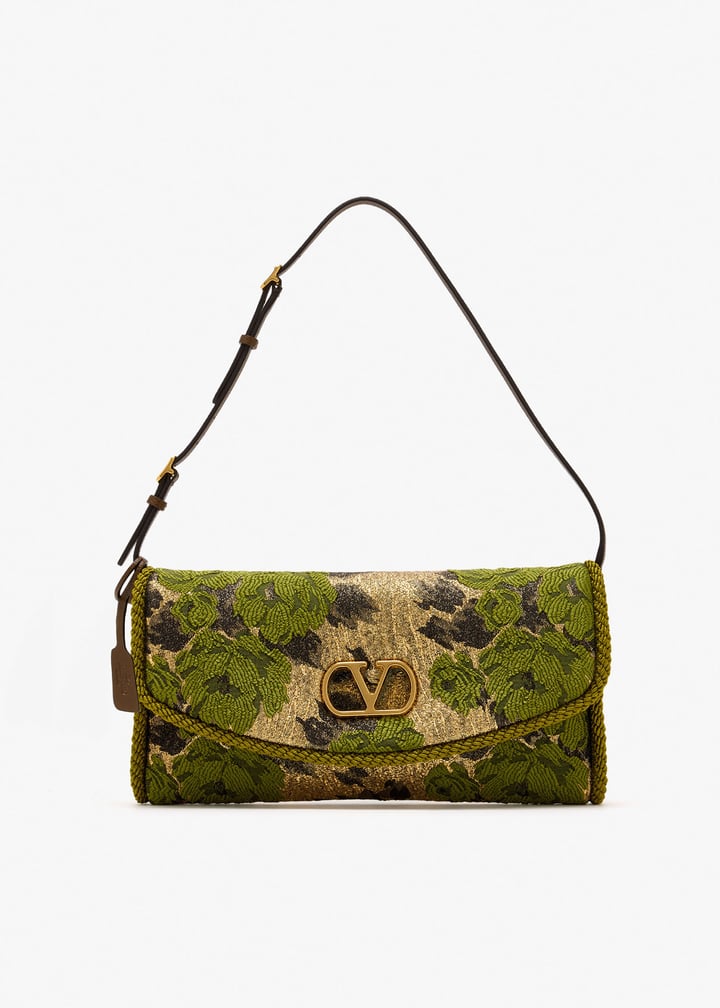
Rockstud Spike: the quilted sibling
Rockstud Spike is its own line rather than a variant, and it costs considerably more. Prices observed run $2,400 for a crossbody clutch up to $3,700 for a medium embroidered nappa piece. The distinguishing features are quilting and a chain, with studs set into the quilted surface instead of lined along an edge. Material drives the price here as well: $2,550 for small suede, $2,800 for small nappa, $2,950 for medium kidskin, $2,750 to $3,200 for medium suede and $3,500 for medium nappa. It reads as an evening bag in a way the standard Rockstud does not, sitting nearer the Locò and VSling families. For the studs on a chain strap with a softer body, this is where to look.
What it costs in 2026
The table gathers the observed prices referenced above into one place. They were seen on the brand’s own US webstore in September 2026 and amount to a market snapshot rather than an official price list. Two patterns are worth noticing. First: standard Rockstud keeps to a narrow band of $1,250 to $2,100 and never reaches the house’s top tier, where embroidery, crystals and exotic skins push bags past $7,000. The second is that Rockstud Spike starts about where standard Rockstud stops, so that the two barely overlap. Official seasonal sales are run on the house’s own site, and as of September 2026 the US sale page states that the Spring/Summer 2026 sale has ended — a Valentino bag sale is a periodic event, and not a permanent condition.
| Piece | Material used | Observed 2026 market price |
|---|---|---|
| Rockstud chain wallet | Laminated calfskin | $1,250 observed |
| Rockstud mini shopping | Grainy calfskin or suede | $1,390 observed |
| Rockstud mini shopping | Raffia | $1,490 observed |
| Rockstud small crossbody | Grainy calfskin | Roughly $1,650 to $1,950 |
| Rockstud mini shopping | Pony-effect calfskin | $1,850 as seen |
| Rockstud small shoulder | Grainy calfskin | $2,100 observed |
| Rockstud Spike medium | Embroidered nappa | $3,700 |
Materials, hardware and care
Across the family, nappa, grainy calfskin, laminated grainy calfskin, suede, kidskin and pony-effect calfskin are the leathers observed, with raffia turning up on seasonal pieces. Hardware finishes seen on current stock include antique brass, light gold and a platinum-toned metallic. On a genuine piece the studs come as uniform pyramids, evenly spaced and firmly seated; the logos are engraved rather than printed; the zip pulls are squared with deep engraving. The interior tag carries VALENTINO and GARAVANI in capitals with MADE IN ITALY, sewn on all four sides, and that surname is required by a 1979 coexistence agreement with the unrelated Naples company Mario Valentino. A serial number is usually found on a tag inside an interior pocket, although not every bag has one and older pieces may carry none; its absence proves nothing, and there is no date-code system to decode. Day-to-day care follows general luxury-leather practice rather than official instruction from the house.
- Grainy calfskin and nappa: clean with a dry cloth, feed with nappa cream, blot stains, air dry away from heat.
- Suede and kidskin: brush dry, protector spray, no water or oils.
- Laminated and pony-effect finishes: the coating fails first, so avoid abrasion.
- Storage: use the dust bag, stuff with tissue, and keep it cool, dry and out of sunlight.
How well the line holds value
Rockstud is the part of the collection that resale data rewards, although the numbers describe market behaviour rather than an investment case. Rebag’s figures put average retention for Valentino handbags at around 41 per cent, measured in 2023, and several Rockstud shapes sit above that. Across the house the pattern repeats: an immediately legible motif keeps value, and plain bags do not. A single-source data point puts a medium Rockstud Spike around $1,700 against roughly $2,900 new, close to sixty per cent. Across one aggregator’s pre-owned inventory the range is $54 to $6,300, the average near $817. Fashionphile, The RealReal, Rebag, Vestiaire Collective and 1stDibs all carry it, so checking the tracked retention figures below takes only minutes.
- Rockstud drawstring bucket, retaining 56 per cent of original price.
- Rockstud flip lock flap, 56 per cent.
- Rockstud pouch crossbody — 50 per cent.
- Valentino handbags overall in 2023, 41 per cent.
Is it worth it for you?
The argument for the Rockstud is practical rather than prestige-driven, and it stands on three points. It provides the cheapest entry to the house’s leather goods in a real bag shape, it is the brand’s most recognisable output, and it resells above the house average. Against that, the studs date a bag to a specific design era, the mini sizes are genuinely small, and the delicate finishes ask for care. One bag, used daily: the small crossbody or the small shoulder bag in grainy calfskin. Evenings call for Rockstud Spike instead, at roughly a thousand dollars more. Stay with the house’s own boutiques and webstore or named authorised retailers such as Neiman Marcus, Saks Fifth Avenue, Nordstrom or Mytheresa, and check the interior tag before anything else.

 Instagram Seara
 Facebook Seara
 LinkedIn Seara
 Twitter Seara
 Email Seara